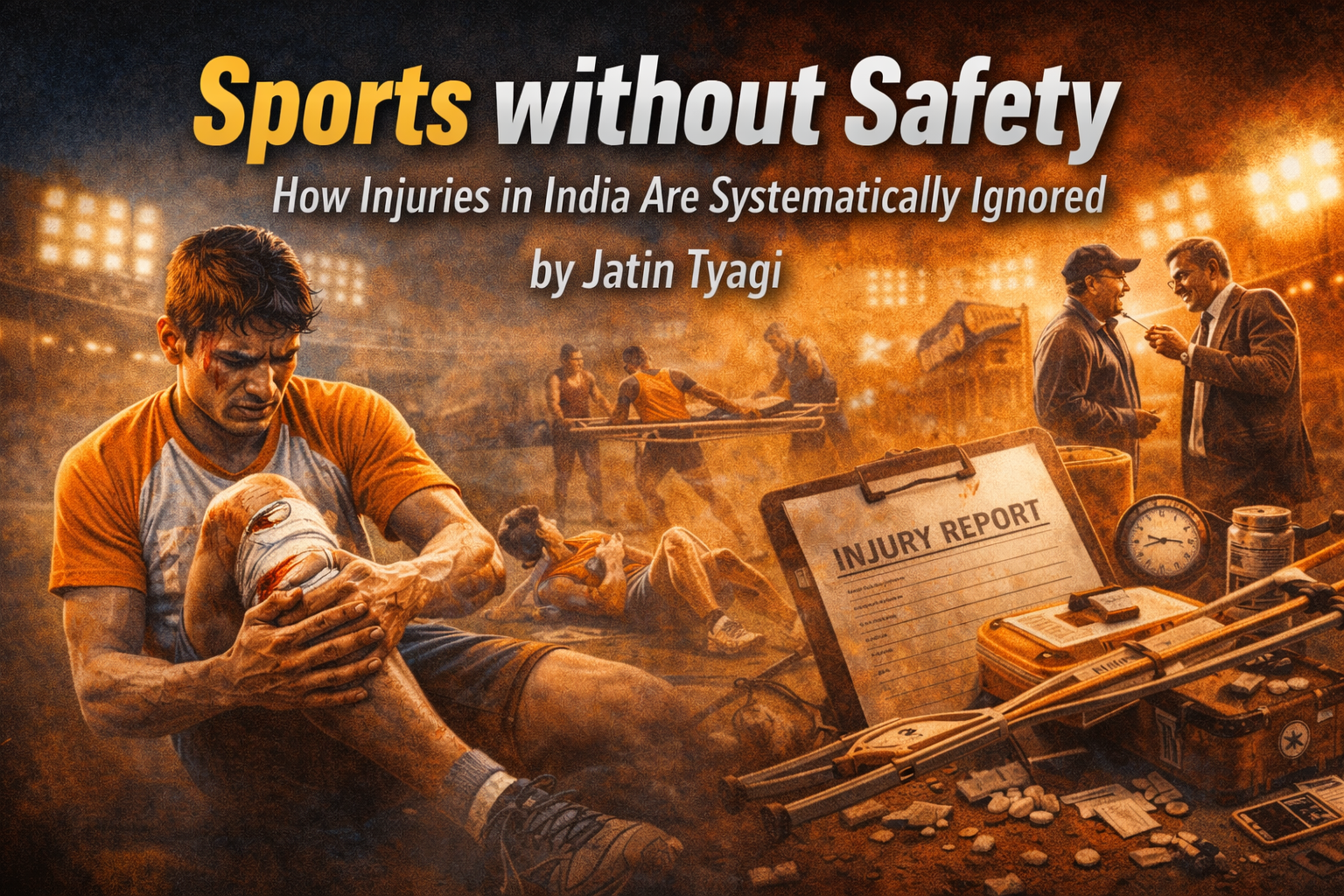
India celebrates sporting success loudly.
But it remains disturbingly silent about injured athletes.
This article is not written to blame individuals.
It is written to expose a system.
A system where injuries are normalized, hidden, delayed, and dismissed.
A system where “playing through pain” is praised, but protecting athletes is postponed.
A system where medals are remembered, but damaged bodies and broken minds are forgotten.
I write this not as an outsider, but as someone who has closely observed Indian sport at grassroots, academy, and competitive levels.
And the truth is uncomfortable:
In India, sports injuries are not just accidental — they are systematically ignored.
Why I Am Writing This
Over the years, I have interacted with young athletes, parents, coaches, trainers, and administrators. I have listened to stories that never make headlines:
- A promising athlete whose knee injury was called “manageable” until surgery became unavoidable
- A young player pushed back into competition before full recovery
- An athlete who lost selection because they asked for medical rest
- Parents confused, helpless, and afraid to question authority
What troubled me most was not the injury itself — injuries happen in sport.
What troubled me was the culture of silence, denial, and delay surrounding them.
Injury Is Treated as Weakness, Not Warning
In many Indian sports environments, injury is seen as:
- A lack of mental toughness
- An excuse
- A temporary inconvenience
Rarely is it treated as a serious medical and ethical concern.
Athletes quickly learn an unspoken rule:
If you talk about pain, you risk losing your place.
This mind set is dangerous — and deeply unfair.
The Glorification of Playing Through Pain
Indian sport still romanticizes suffering.
We praise stories of athletes who:
- Played with fractures
- Competed while injured
- “Sacrificed everything” for the team
But what we do not ask is:
- Who paid the long-term cost?
- What happened after retirement?
- Who took responsibility for permanent damage?
Pain should be managed, not glorified.
Systemic Reasons Injuries Are Ignored
- Performance Pressure over Athlete Health
From district to national levels, performance metrics dominate decision-making:
- Trials
- Rankings
- Selections
- Funding
In this race:
- Rest is seen as laziness
- Recovery is seen as delay
- Medical caution is seen as risk
The athlete’s body becomes a resource — not a responsibility.
- Lack of Independent Medical Authority
In many setups:
- Medical decisions are influenced by coaches or management
- Athletes do not have access to independent second opinions
- Return-to-play timelines are rushed
When performance goals influence medical calls, athlete safety suffers.
- Absence of Injury Protocols
Unlike global best practices, many Indian sports environments lack:
- Standard injury assessment frameworks
- Mandatory rest periods
- Rehabilitation compliance checks
- Injury reporting systems
Without protocols, injuries become subjective — and therefore easy to ignore.
- Fear-Based Athlete Culture
Athletes often stay silent because they fear:
- Being replaced
- Losing scholarships
- Missing selections
- Being labelled “injury-prone”
This fear forces athletes to choose between health and career — a choice they should never have to make.
Parents: The Most Confused Stakeholders
Parents trust systems blindly because:
- They lack medical knowledge
- They fear harming their child’s prospects
- They believe authorities know best
But many parents later realize — painfully — that early intervention could have prevented lifelong damage.
Parents should be partners in athlete safety, not spectators of harm.
Mental Injuries Are Even More Invisible
Physical injuries at least show symptoms.
Mental injuries are easier to ignore.
Athletes dealing with:
- Burnout
- Anxiety
- Depression
- Fear of re-injury
Are often told to:
- “Be strong”
- “Focus”
- “Stop overthinking”
Mental distress without support eventually becomes withdrawal, breakdown, or exit from sport.
The Long-Term Cost of Ignored Injuries
Ignoring injuries doesn’t end when competition ends.
It leads to:
- Early arthritis
- Chronic pain
- Mobility limitations
- Mental health struggles
- Career instability post-retirement
We must ask ourselves:
Is success worth a lifetime of suffering?
My Vision: Injury-Safe, Athlete-Centered Sports
I believe India can build sporting excellence without sacrificing athlete well-being.
My vision is clear:
A sports ecosystem where:
- Injury reporting is mandatory and protected
- Medical decisions are independent
- Rest and recovery are respected
- Rehabilitation is tracked, not rushed
- Mental health care is normalized
- Athletes are never punished for prioritizing health
Safety must become non-negotiable, not optional.
Message to Athletes
If you are injured:
- Speak up
- Seek medical clarity
- Protect your future
Your body is not replaceable.
Your career should not cost your health.
Message to Coaches
Coaching is not only about results.
True leadership means:
- Protecting athletes from long-term harm
- Listening when athletes report pain
- Valuing sustainability over short-term success
A broken athlete cannot build a winning legacy.
Message to Institutions & Policymakers
If India wants sustainable sporting success, injury management must become a governance issue.
Every federation, academy, and association must answer:
- Who decides medical fitness?
- Who is accountable for injury negligence?
- What safeguards protect athletes from pressure?
Without accountability, neglect will continue.
Why Reform Cannot Be Delayed
Every season without reform means:
- More preventable injuries
- More silent suffering
- More athletes leaving sport prematurely
Reform is not anti-competition.
Reform is pro-athlete, pro-future, and pro-India.
My Commitment as a Sports Reformer
As Jatin Tyagi, I commit to:
- Raising injury safety as a national sports issue
- Advocating independent medical governance
- Promoting athlete education and rights
- Challenging cultures that normalize neglect
Indian sport must be remembered for excellence — not exploitation.
A Defining Quote
“Injuries are not signs of weakness. They are warnings — and ignoring them is the real failure of sport.” — Jatin Tyagi
Conclusion: Safety Is Not the Enemy of Success
Sport is meant to build:
- Strength
- Discipline
- Confidence
- Character
When safety is ignored, sport breaks what it was meant to build.
If we truly respect athletes, we must protect them — before, during, and after competition.
Because a nation that values medals over lives will eventually lose both.
About the Author
Jatin Tyagi is a sports reformer, activist, and social impact advocate committed to creating ethical, athlete-centered, and mentally resilient sports environments. His work emphasizes youth development, sports integrity, and lasting athlete well-being.
#AthleteSafety #SportsInjuries #IndianSports #SportsReformer #AthleteFirst #MentalHealthInSports #EthicalSports #JatinTyagi