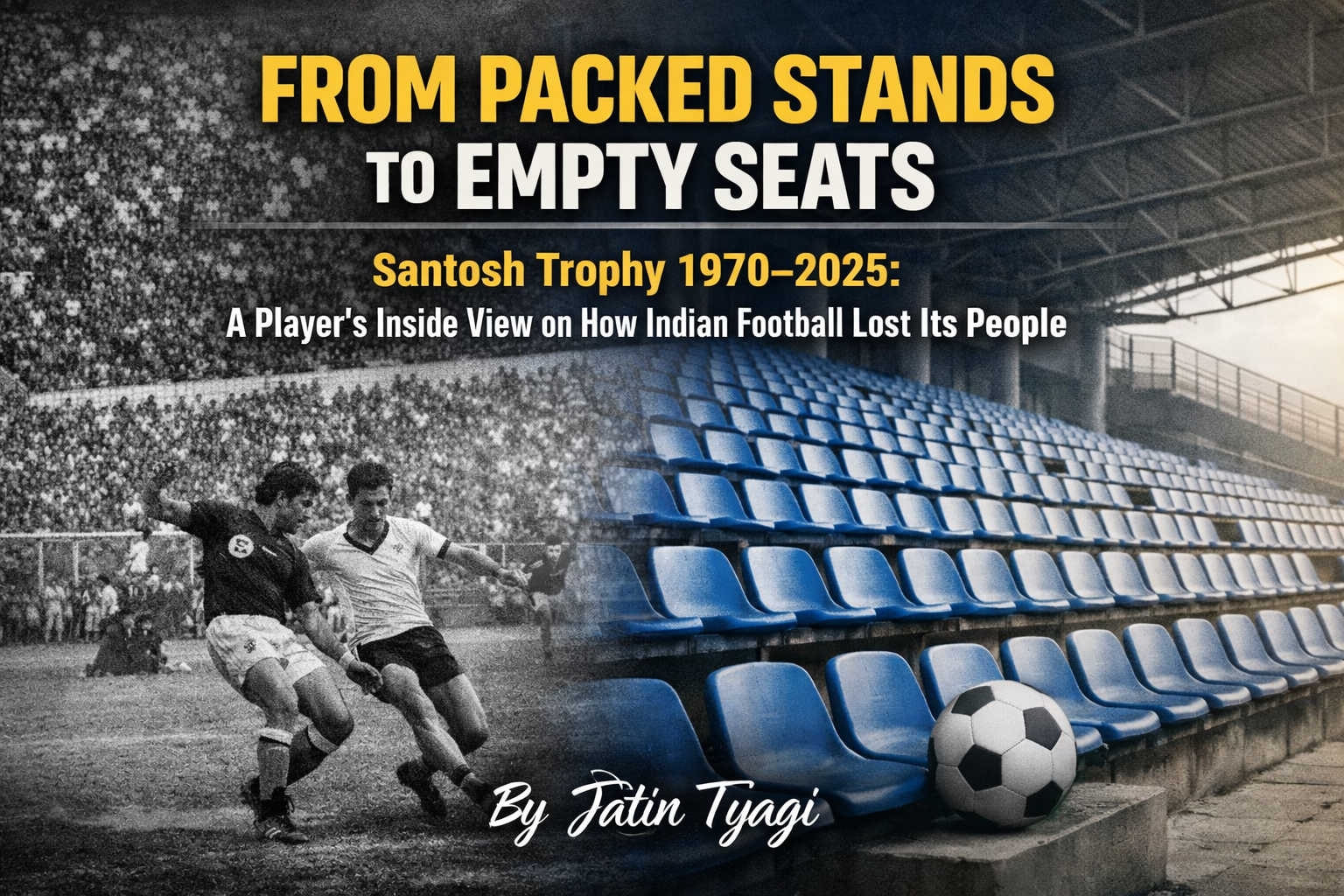
Santosh Trophy 1970–2025: How Indian Football Lost Its People — A Player’s Inside View on What Went Wrong and What Must Change
By Jatin Tyagi
Sports Reformer | Former Footballer | Youth & Athlete Safety Advocate
When Stadiums Reflected Society’s Love for Football
In the 1970s, Indian football stadiums were not quiet places.
They were emotional, loud, imperfect — but alive.
The historic photograph from the 1970 Santosh Trophy Final, where Mysore’s Saptakumar attempts to stop the legendary Jarnail Singh, is more than a football image. It is a cultural record. The background is filled with spectators — not invited guests, not officials — but ordinary people who belonged to the game.
Santosh Trophy was once:
- A symbol of state pride
- A scouting ground for national heroes
- A tournament families planned their lives around
Now move forward to 2025.
During the 79th Santosh Trophy Group-B matches at Sharda University Stadium, Agra, large sections of the stands were empty. Silence replaced anticipation. Empty seats replaced community.
Only one match felt different — 25 December, when Uttarakhand played host Uttar Pradesh. Supporters arrived with drums, banners, and emotion. For a few hours, the stadium echoed again.
That single match proved a crucial point:
Indian football does not have a fan problem. It has a governance and connection problem.
Why This Issue Is Personal for Me
I am not analysing Indian football from outside the system.
I have:
- Played 3–5 Santosh Trophy tournaments
- Been part of 12+ Santosh Trophy selection camps, probables, and competition environments
- Closely observed multiple state teams from inside dressing rooms and camps
- Been associated with Haryana Santosh Trophy (2022–23, Kolhapur)
Over the years, I have directly observed football administration and team processes in:
- Delhi (2018 period)
- Andaman & Nicobar Islands (2021)
- Haryana (2022)
- Chandigarh
- Rajasthan
- Lakshadweep
This article is written from lived experience, not assumptions.
And what I have seen repeatedly is this:
The decline of Indian football audiences begins long before match day — it begins at the selection table.
The Hidden Root Cause: Selection to Stadium Is One Broken Chain
Indian football discussions often start at “empty stadiums”.
But the real damage begins much earlier.
- Selection without Transparency Kills Belief
Across multiple states and years, one pattern repeats:
- Late selection notifications
- Unclear criteria
- Preference-based inclusions
- Lack of documented performance metrics
When players feel selection is uncertain or biased:
- Motivation drops
- Ownership drops
- Pride in representing the state weakens
And when players stop believing, fans never get a reason to believe either.
- Camps That Break Players Instead of Building Teams
Santosh Trophy camps should be:
- High-intensity
- Professionally planned
- Mentally supportive
What I observed instead in several states:
- Poor facilities
- Inconsistent training schedules
- No sports psychology support
- Lack of communication from management
In some camps (including observed environments in Delhi, Rajasthan, and island territories), players were unsure:
- Whether they were confirmed
- What role they would play
- What the long-term plan was
A confused team can never inspire a crowd.
- Team Participation without Local Identity
In many states, Santosh Trophy teams are assembled without:
- Local club storytelling
- Player visibility
- Community integration
Fans don’t come to watch unknown names chosen at the last moment.
They come to support:
- Familiar faces
- Local heroes
- Players they have seen grow
When teams feel temporary, fans treat matches as optional.
Why Fans Stayed Away (The Stadium Reality)
1 Football Was Never Developed Like Cricket
Cricket invested in:
- Heroes
- Narratives
- Media
- Fan rituals
Football administration focused on procedures, not people.
2️ Hosting Matches in Non-Football Cities
Santosh Trophy is often hosted where:
- Football culture is weak
- Local engagement is zero
- Hosting is treated as a formality
Meanwhile, football-centric regions remain underutilised.
3️ VIP Culture over Match Experience
Long inaugural ceremonies, delayed kick-offs, and endless speeches drain energy.
Football is not a conference.
It is an emotion.
4️ No Real Fan Campaigns
No serious effort is made to:
- Market matches
- Promote players
- Create local pride
You cannot expect fans without inviting them properly.
5️ Players Are Invisible, Officials Are Visible
Across states, I observed:
- Officials front-facing communication
- Players discouraged from speaking
- Fear of posting on social media
Fans connect with players — not associations.
6️ Media Is Treated as an Accessory
Without structured media engagement:
- Matches remain invisible
- Stories go untold
- Heroes remain unknown
A silent sport cannot grow.
7️ Youth & Institutions Are Ignored
Schools, colleges, and universities are rarely mobilised.
A generation that never experiences live football will never defend it.
Data That Supports What We Feel
- Domestic football (excluding ISL) averages very low attendance compared to other Asian nations
- State tournaments in football-centric regions still draw 5,000–15,000 spectators, proving demand exists
- Santosh Trophy attendance often drops to hundreds, not because of quality, but because of disconnect
This confirms one truth:
The problem is not football. The problem is how football is run.
1970 to 2025: What Changed?
Football didn’t lose fans overnight.
It lost them gradually through:
- Non-transparent systems
- Fear-based administration
- Poor communication
- Loss of player dignity
- Absence of reform mind-set
Fans don’t abandon football.
Football abandons fans first.
My Vision for Santosh Trophy & Indian Football
Santosh Trophy must return to being:
- A festival of state identity
- A platform for genuine talent
- A tournament players dream of
- A competition fans feel proud to attend
What Must Change (Reform, Not Blame)
✔ Transparent Selection Systems
Clear criteria, timelines, and communication.
✔ Professional Camps
Facilities, planning, psychology, and respect.
✔ Player-Centric Promotion
Players must be the face of football.
✔ End VIP-First Culture
Football first. Always.
✔ Media & Digital Strategy
Visibility creates belief.
✔ Youth Integration
Students must return to stadiums.
A Quote I Stand By
“Crowds are not ordered. They are earned.
And football earns them only when it respects players, fans, and the process.”
— Jatin Tyagi
Conclusion: This Is a Call, Not a Complaint
This article is not written in anger.
It is written in responsibility.
Indian football still has:
- Talent
- Passion
- History
- Youth
What it needs is honest reform and courage to change.
The empty stadiums are not the end.
They are a warning.
And warnings should lead to action — not silence.
#SantoshTrophy #IndianFootball #FootballReform #PlayersFirst #SportsGovernance #SaveIndianFootball #YouthInSports #JatinTyagi #SportsReformer #IndianFootballForwardTogether #SaveSports #JTF