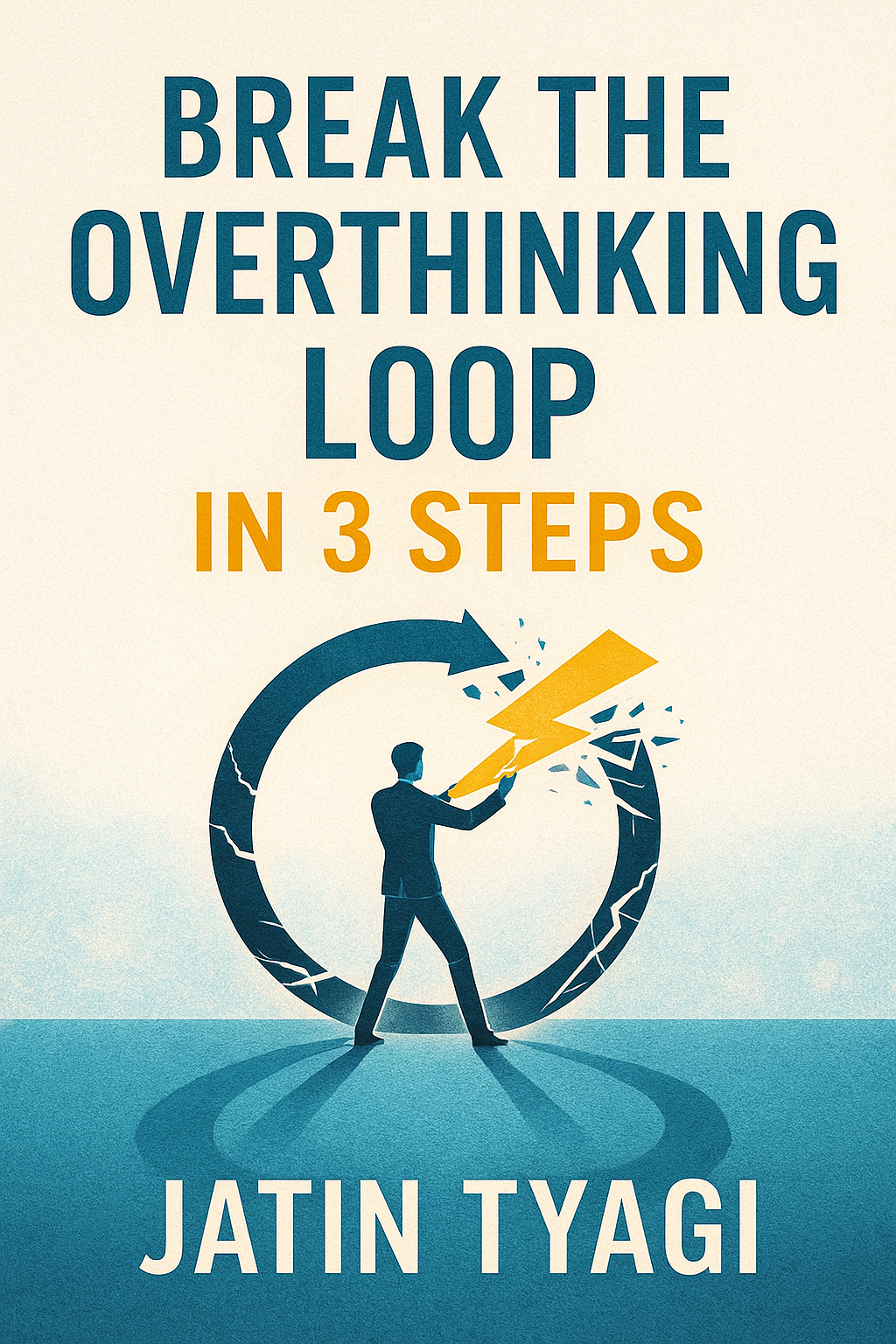
Introduction — The Modern Problem No One Escapes
If there is one mental habit silently destroying clarity, peace, confidence, and decision-making in today’s generation, it is overthinking.
Overthinking does not shout.
It whispers.
Slowly.
Quietly.
But powerfully.
It makes you:
- doubt everything,
- question your abilities,
- fear your decisions,
- replay conversations,
- imagine worst outcomes,
- and waste hours trapped inside your mind.
If you’ve ever felt stuck because of your own thoughts, I want to tell you something from my heart:
Overthinking is not a personality trait.
It is a pattern.
And patterns can be changed.
This article is my most personal one so far, because I’ve seen overthinking destroy motivation, relationships, opportunities—and most importantly, mental peace.
I want to show you a simple, powerful, psychology-based method I personally teach:
“The Overthinking 3-Step Technique.”
It is not complex.
It is not theoretical.
It is not something you will forget in 10 minutes.
It is actionable, human, and designed to give you instant clarity.
My Vision
My vision is deeply personal:
To create a generation that thinks clearly, decides confidently, and lives peacefully—without being trapped by their own mind.
We don’t need more stress.
We don’t need more pressure.
We don’t need more confusion.
What we need is:
- mental clarity,
- emotional stability,
- and psychological awareness.
Overthinking kills all three.
My vision is to help you break this cycle—not temporarily, but permanently.
My Core Message
“Your mind should be your tool, not your prison.” — Jatin Tyagi
You deserve clarity.
You deserve peace.
You deserve to think in a way that supports your growth—not destroys it.
Overthinking is not a sign of intelligence.
Intelligence is the ability to think clearly, not endlessly.
My message is simple:
“When you learn to control your mind, you learn to control your life.”
The technique you’re about to learn is the foundation of that control.
Quote
“Overthinking doesn’t give you answers.
It only steals the clarity you already had.” — Jatin Tyagi
Why You Overthink (The Real Psychology behind It)
Before I teach you the technique, you must understand why your brain overthinks at all.
Because when you understand the root, the solution becomes easier.
- Your mind wants safety, not clarity
Your brain’s job is survival.
Not happiness.
Not confidence.
Not growth.
So when it senses:
- uncertainty,
- potential risk,
- emotional pain,
- possible rejection,
- important decisions…
…it goes into analysis mode.
This is the brain trying to protect you—even when the threat is not real.
- You overestimate danger and underestimate your ability
Overthinking comes from one core belief:
“What if I’m not enough?”
Not good enough…
Not prepared enough…
Not smart enough…
Not ready enough…
Overthinking hides behind fear of inadequacy.
- You lack emotional processing, so your mind takes over
Your mind overthinks because your emotions are unprocessed.
Your brain tries to “think its way” out of feelings that actually need:
- acceptance,
- understanding,
- patience,
- clarity,
- expression.
When emotions are ignored, thoughts explode.
- You live in a world of constant comparison
Overthinking increases when you compare yourself to:
- friends
- classmates
- colleagues
- influencers
- social media highlights
Comparison leads to doubt.
Doubt leads to overthinking.
- You haven’t developed mental discipline
Your mind will run wild unless you train it.
Overthinking is a lack of mental training—not lack of intelligence.
What Overthinking Really Does to You
Overthinking feels harmless.
But psychologically, it damages you deeper than you realize.
It causes:
✔ Paralysis
✔ Anxiety
✔ Self-doubt
✔ Delay
✔ Stress
✔ Regret
✔ Confusion
✔ Emotional exhaustion
It leads to:
✘ Missed opportunities
✘ Broken relationships
✘ Constant fear
✘ Low confidence
✘ Slow growth
And worst of all:
It traps you in the illusion that “thinking more = solving more.”
No.
Thinking endlessly never solves problems.
Thinking correctly does.
That’s why I created this simple method.
The Overthinking 3-Step Technique (Jatin Tyagi Method)
This technique works because it is not theoretical.
It is built on human psychology + practical application + real-world behavior patterns.
Let’s break it down.
STEP 1: STOP THE THOUGHT — “Interrupt the Loop”
When you start overthinking, you enter a mental loop.
The brain keeps repeating:
- “What if…?”
- “But what about…?”
- “I should have…”
- “Why did they…?”
- “I hope I don’t…”
The FIRST step is not to solve anything.
The first step is to interrupt the loop.
How to interrupt the loop:
- a) Name the pattern
Say in your mind (or out loud):
👉 “I am overthinking. This is not clarity. This is fear.”
Naming reduces emotional power.
It activates the logical brain.
- b) Pause for 10 seconds
Close your eyes.
Take a slow breath.
Release it.
This signals the brain:
“Stop spinning. Reset.”
- c) Ask this question:
‘Is this a problem or a prediction?’”
Most overthinking is not a problem.
It is a fear-based prediction.
This question breaks the illusion.
STEP 2: CLARIFY THE FACTS — “Separate Reality from Imagination”
Overthinking mixes:
- facts
- fears
- assumptions
- stories
- past memories
- insecurities
Your job is to separate them.
Use this simple breakdown:
- a) Write down the actual situation
One sentence.
Clear.
No drama.
Example:
“Tomorrow I have a presentation.”
- b) Write down your fear
Example:
“I’m scared I’ll forget something.”
- c) Write the evidence
👉 “Has this ever actually happened?”
👉 “Is this fear based on real facts or imagination?”
You’ll be shocked how weak the fear is when you challenge it.
- d) Focus only on things you can control
Example:
You cannot control:
- how people react
- what they think
- unexpected situations
You CAN control:
- preparation
- attitude
- behavior
- response
When you focus on controllables, overthinking loses power.
STEP 3: TAKE A SMALL ACTION — “Break the Thought with Movement”
Action ends overthinking.
Not motivation.
Not logic.
Not wishing.
Not positive thinking.
Only action breaks the cycle.
But not big action.
Not overwhelming action.
Not perfect action.
Just one small action.
Examples:
- If you’re overthinking your career → write down your top 3 interests.
- If you’re overthinking a conversation → send one honest message.
- If you’re overthinking a goal → complete a 5-minute task.
- If you’re overthinking a decision → choose the option that aligns with values.
- If you’re overthinking due to fear → take a small courageous step.
Movement changes your mental state.
Psychology calls this behavioral activation.
Once you act, your brain calm downs.
The overthinking ends.
Clarity returns.
Why This Technique Works (Psychology Breakdown)
- Step 1 interrupts the emotional brain (amygdala).
You stop the panic cycle. - Step 2 activates the logical brain (prefrontal cortex).
You get clarity. - Step 3 builds momentum and reduces fear.
Action creates confidence.
This is why the technique works for:
- anxiety
- fear
- decision paralysis
- relationship overthinking
- career confusion
- self-doubt
- emotional overwhelm
Because it treats the root, not the symptoms.
A Real-Life Example (Personal Perspective)
Let me share a story—not dramatic, but honest.
There was a time when I had to make a major career decision.
I knew the right choice, yet I kept delaying it.
Every night, the same thoughts came:
- “What if it doesn’t work out?”
- “What if people don’t understand?”
- “What if I fail?”
I wasn’t confused—
I was overthinking.
One day, I wrote down the exact fears.
When I saw them on paper, they suddenly looked… small.
So I took one small action.
Not a huge decision.
Just a small step.
And that one step changed the direction of my life.
That’s when I realized:
Overthinking is not a lack of options.
It is a lack of action.
And since then, I’ve used the same 3-step technique with thousands of students and working professionals.
It works.
Every single time.
10 Signs You’re Overthinking (Be Honest)
✔ You replay past conversations
✔ You imagine worst-case scenarios
✔ You fear making mistakes
✔ You struggle to make decisions
✔ You keep asking “What if?”
✔ You create problems that don’t exist
✔ You feel mentally exhausted
✔ You always worry about others’ opinions
✔ You think more than you act
✔ You cannot stay in the present moment
If 6 or more match,
you don’t have a clarity problem—
you have an overthinking habit.
But habits can be changed.
How to Make the 3-Step Technique a Daily Habit
Do this:
Morning (1 min):
Set intention:
“Today I control my thoughts.”
During the day:
Whenever you overthink:
→ Step 1
→ Step 2
→ Step 3
Night (2 mins):
Write the best decision you made today.
This builds confidence.
Within 7 days, you will feel:
- calmer,
- clearer,
- stronger,
- more focused.
Within 21 days, the technique becomes natural.
SEO Section — Naturally Integrated Keywords
This article is optimized with keywords like:
- Overthinking solutions
- How to stop overthinking
- Overthinking 3-step method
- Mental clarity techniques
- Break overthinking habit
- Jatin Tyagi overthinking guide
- Reduce anxiety and overthinking
- Practical steps to stop overthinking
- Overthinking psychology explained
These help the article rank for students, professionals, and mental clarity seekers.
Conclusion — Your mind is powerful. Use it wisely.
Overthinking is not strength.
Overthinking is not depth.
Overthinking is not intelligence.
Overthinking is simply:
- fear disguised as logic,
- worry disguised as analysis,
- doubt disguised as thinking.
And once you learn this 3-step technique, everything changes.
- Stop the thought
Interrupt the loop.
- Clarify the facts
Separate truth from imagination.
- Take a small action
Break the pattern.
Do this consistently, and you will escape overthinking permanently.
Final Message from Me (Jatin Tyagi)
“Clarity is not found by thinking more.
It is found by thinking less—and acting more.”
You deserve peace.
You deserve clarity.
You deserve a mind that supports your growth, not your fear.
And with this technique, you’ll get exactly that.
#OverthinkingSolution #JatinTyagi #NationalYouthIcon #YouthMentor #MindsetCoach #ClarityMethod #MentalHealth #StopOverthinking #SelfGrowth #ClarityOverChaos #PsychologyTools #ThinkClearly #JatinTyagiFoundation #CoachTyagi #thetyagisway #youthsaviour #JatinTyagiQuotes