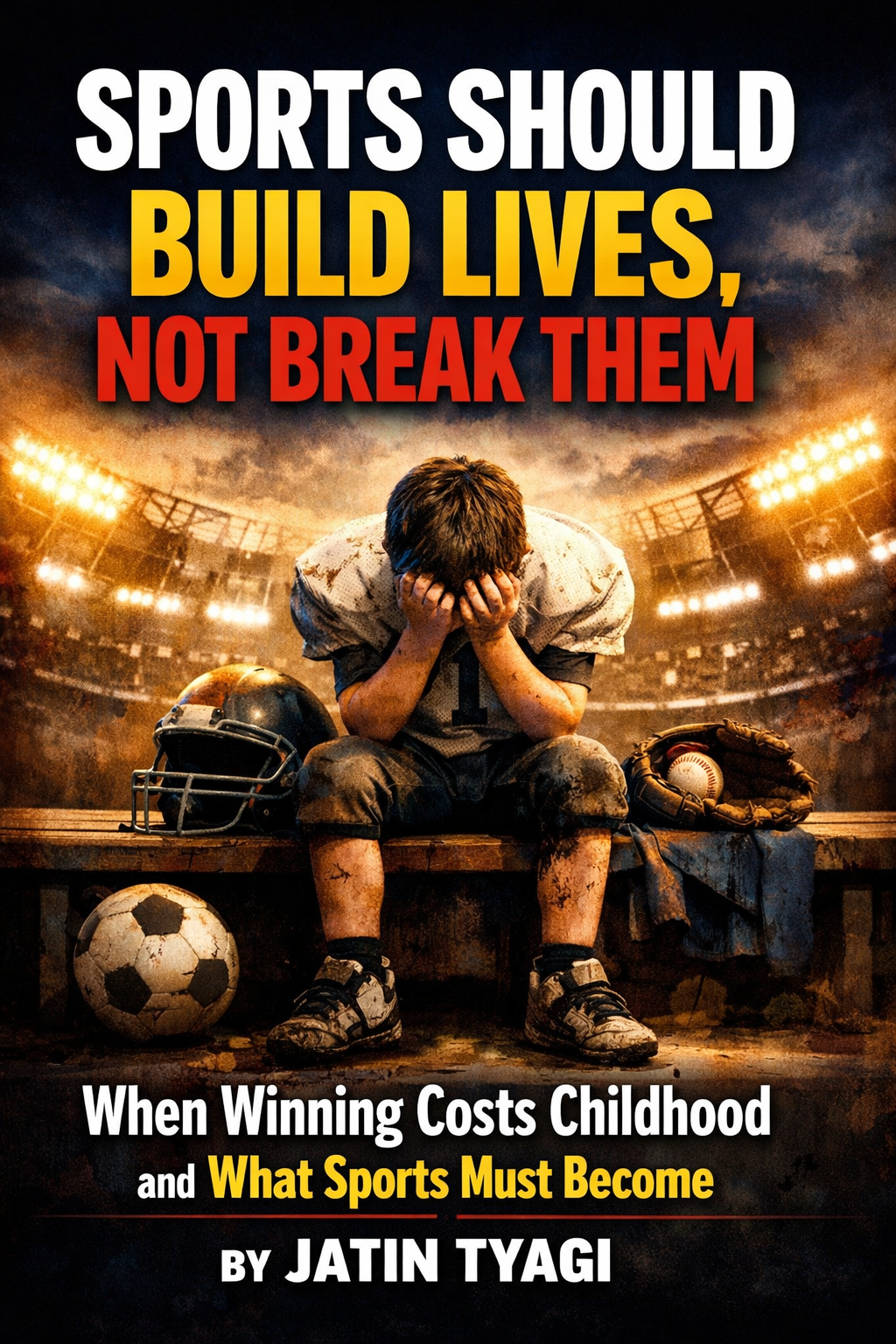
Sports can create champions—or casualties.
Somewhere between medals, rankings, and pressure, we forgot its true purpose.
This is not an attack on sports.
It is a call to reform it.
Why I Am Writing This
I have seen two kinds of silence in sports.
One is the silence of a stadium after a loss.
The other is more disturbing—the silence of a young athlete who stops believing in themselves.
Over the years, I have interacted closely with athletes, coaches, families, and institutions. I have met talented young players who trained hard, followed discipline, and sacrificed deeply—yet carried invisible burdens: fear of failure, fear of rejection, fear of disappointing adults.
Many were not weak.
They were simply unsupported.
That is when I began asking a question that still drives my work:
If sports is meant to build strength, why are so many athletes breaking inside?
This article is my answer.
What Sports Was Always Meant to Be
Sports was never designed to be a pressure cooker.
Its original purpose was holistic:
- To strengthen the body
- To discipline the mind
- To teach teamwork, respect, and resilience
- To prepare individuals for life, not just victory
Historically, sports functioned as a school of character.
Winning mattered—but becoming a better human being mattered more.
Somewhere between commercialization, early specialization, rankings, and obsession with results, this balance was lost.
A Moment I Will Never Forget
I once spoke to a teenage athlete who had trained for years. After failing to get selected at the next level, he said quietly:
“Sir, I don’t know who I am without my sport.”
He did not ask how to improve.
He did not talk about technique or fitness.
He questioned his identity.
That single sentence exposed the biggest failure of modern sports systems:
We prepare athletes to compete—but not to live.
What Is Breaking Athletes Today
- Adult Pressure on Child Minds
Children are now trained with professional expectations before they develop emotional strength.
They face:
- Constant comparison
- Fear-based motivation
- Performance anxiety
- Conditional appreciation
A child must first enjoy sport.
When joy disappears, excellence becomes unsustainable.
- The Win-at-All-Costs Culture
In many systems today:
- Winning defines worth
- Losing invites shame
- Learning becomes secondary
This culture creates:
- Early burnout
- Fear-driven performance
- Short-term results, long-term damage
Medals achieved by breaking minds are not success—they are warnings.
- Mental Health Is Still Ignored
Physical injuries get immediate attention.
Mental exhaustion is often dismissed as weakness.
Athletes silently deal with:
- Anxiety and self-doubt
- Identity loss
- Emotional isolation
- Fear of speaking up
Very few systems offer:
- Psychological support
- Emotional mentorship
- Safe communication spaces
An athlete is not a machine.
They are human beings under intense pressure.
- No Life-After-Sports Planning
A hard truth we must confront:
Most athletes will not retire as champions—but all will retire as humans.
When careers end due to injury, non-selection, or age, many athletes are left unprepared:
- No education pathway
- No career transition support
- No emotional closure
Sports should never abandon its children.
My Vision: A Human-Centered Sports System
I do not believe sports is the problem.
The system around it is.
My vision is simple yet firm:
A sports ecosystem where:
- Athlete well-being equals performance
- Failure is treated as feedback
- Mental health is normalized
- Education and sport coexist
- Character matters as much as capability
Sports must build strong humans first, strong athletes second.
What Sports Should Truly Build
Confidence, Not Fear
True confidence is built when athletes are:
- Allowed to fail
- Corrected with dignity
- Supported consistently
Fear may produce obedience.
Confidence produces excellence.
Discipline with Dignity
Discipline does not require:
- Insults
- Public humiliation
- Emotional abuse
Real discipline builds self-respect, not resentment.
Identity beyond Results
Athletes must know:
- Their value is not conditional
- Loss does not define them
- Their voice matters
When identity depends only on winning, loss becomes trauma.
Emotional Intelligence
Mental toughness is not emotional suppression.
It is:
- Self-awareness
- Pressure management
- Knowing when to ask for help
Strong athletes feel deeply—and manage wisely.
The Responsibility of Coaches
Coaches hold immense influence.
One sentence can:
- Build belief
- Or destroy confidence
A truth every coach must remember:
You don’t just train athletes—you shape lives.
Coaching is not control.
It is leadership with responsibility.
The Role of Parents
Parents act out of love—but expectations often become pressure.
Children need:
- Encouragement, not constant evaluation
- Support, not comparison
- Emotional safety, not fear of disappointment
A child should never feel love depends on performance.
The Role of Institutions & Federations
Sports bodies must evolve from:
- Medal-centric systems
- To athlete-first ecosystems
This includes:
- Mental health programs
- Education integration
- Career transition planning
- Ethical safeguarding frameworks
Institutions exist for athletes, not the other way around.
My Message to Young Athletes
If you are reading this:
- You are more than your results
- Your struggles do not make you weak
- Your worth is not negotiable
Work hard. Be disciplined. Chase excellence.
But never destroy yourself to prove your value.
Why Reform Cannot Wait
We are losing:
- Talented athletes to burnout
- Passion to pressure
- Potential to outdated systems
If this continues, sports will create:
- Broken champions
- Silent exits
- Disillusioned youth
Sports should uplift society—not reflect its harshest flaws.
My Commitment
As a sports activist and reformer, I commit to:
- Advocating athlete dignity
- Promoting mental health awareness
- Supporting ethical sports development
- Building systems that protect young talent
This is not a slogan.
This is responsibility.
A Defining Quote
“The true success of sports is not how many champions it creates, but how many lives it strengthens along the way.” — Jatin Tyagi
Conclusion: Redefining Victory
Victory is not just standing on a podium.
Victory is:
- An athlete who believes in themselves
- A system that protects its players
- A journey that builds character
Sports should leave people stronger than when they entered.
If sports breaks lives, it has failed.
If sports builds lives, it becomes a force for national and human progress.
That is the sports culture I stand for.
That is the reform I believe in.
That is the future we must build—together.
About the Author
Jatin Tyagi is a sports reformer, activist, and social impact advocate committed to creating ethical, athlete-centered, and mentally resilient sports environments. His work emphasizes youth development, sports integrity, and lasting athlete well-being.
#SportsReformer #AthleteFirst #SportsShouldBuildLives #MentalHealthInSports #YouthDevelopment #EthicalSports #SportsActivist #JatinTyagi #YouthSafetyAdvocate