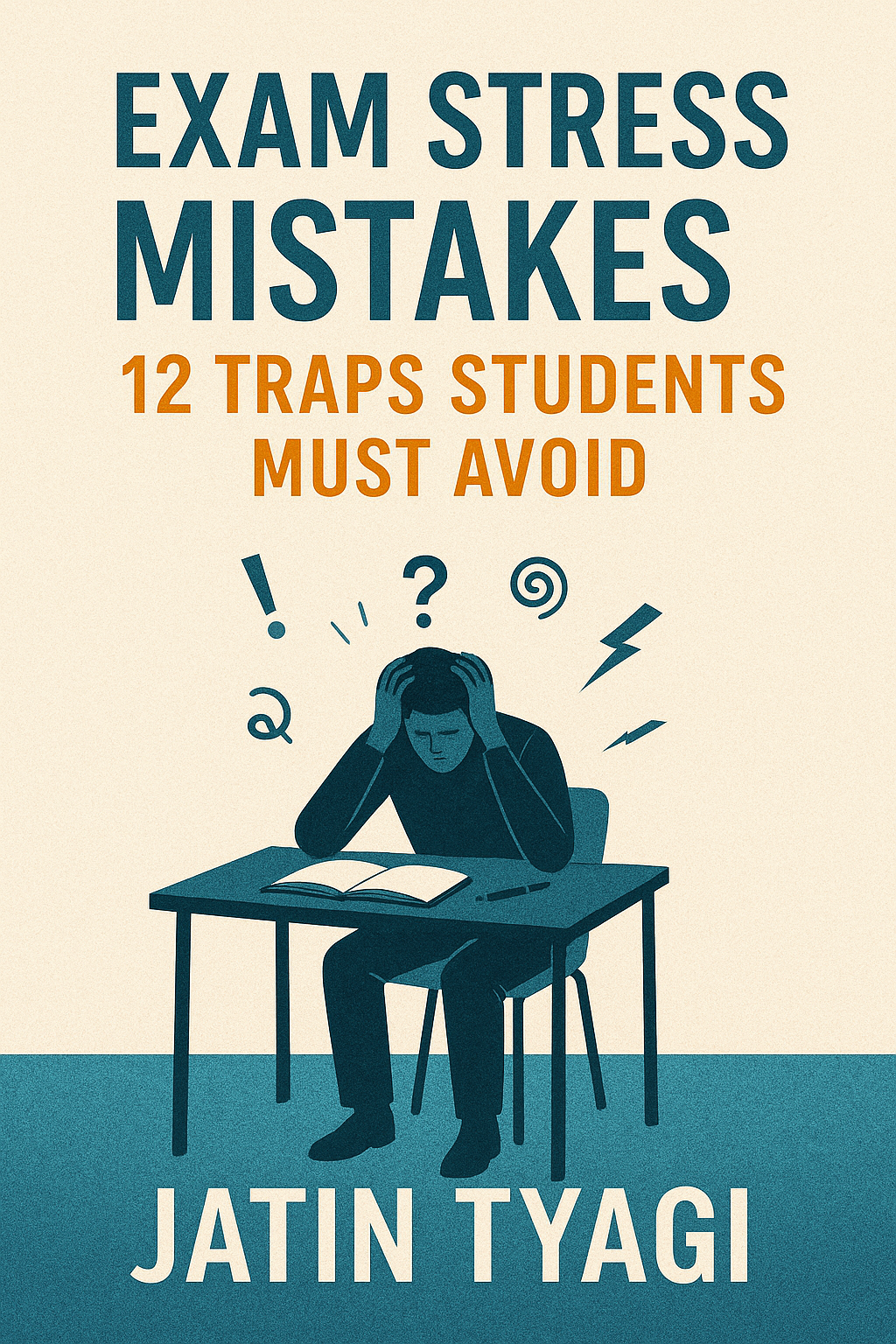
Introduction — A Reality We Don’t Talk About Enough
There is a silent truth every student knows but rarely says out loud:
“Exams don’t just test knowledge.
Exams also test emotions.”
The vast majority of students don’t struggle because they lack intelligence.
They struggle because they lack mental clarity, emotional balance, and exam-season discipline.
Across my years of guiding students, one pattern has always stood out:
Most students don’t fail due to lack of preparation.
They fail due to exam stress and the mistakes that stress creates.
Exam stress is not a weakness.
It is a psychological response.
A natural reaction.
A mismanaged energy.
But the biggest problem?
Students make certain avoidable mistakes which turn simple stress into:
- panic,
- fear,
- self-doubt,
- last-minute pressure,
- unhealthy habits,
- and even burnout.
This article is my sincere attempt to help you understand—and eliminate—those mistakes permanently.
I want you to feel emotionally strong, mentally prepared, and academically confident.
Because you deserve peace—not pressure.
You deserve clarity—not chaos.
And you deserve success—not stress-driven mistakes.
My Vision
My vision is simple but powerful:
“To build a generation that studies with strategy, handles pressure with maturity, and performs with confidence.”
Every student has potential.
Every student can excel.
Every student can score better.
Every student can perform brilliantly under exams.
But this is only possible when students learn how to avoid exam stress mistakes and how to use exams as an opportunity, not a threat.
My vision is to empower students with mind sets, techniques, habits, and clarity that help them perform without panic, fear, or stress.
My Core Message
“You don’t need more hours of study;
You need fewer mistakes during exam season.” — Jatin Tyagi
Stress is not your enemy.
Stress is your signal.
Stress increases when mistakes increase.
Fix the mistakes → Stress drops
Stress drops → Performance increases
Performance increases → Results improve
My message is straightforward:
“Exam results improve instantly
When exam stress mistakes are removed.”
Quote
“You don’t fail because of the exam.
You fail because of the pressure you create before it.” — Jatin Tyagi
Why Students Experience Exam Stress
Before we talk about mistakes, understand the root of exam stress:
- Fear of failure
Students imagine worst-case scenarios before studying even begins.
- Social pressure
Family expectations, comparison with friends, coaching pressure—it all adds weight.
- Time mismanagement
When time is not planned, stress multiplies.
- Previous failures
Past experiences haunt present performance.
- Lack of clarity
Not knowing what to study adds confusion.
- Unhealthy habits
Irregular sleep, excessive screen time, no routine—stress becomes automatic.
- Overthinking outcomes
Students think more about marks than preparation.
These are seeds.
Mistakes are the water.
Stress grows because students unintentionally water it every day.
The 12 Biggest Exam Stress Mistakes Students Make
These mistakes appear small but create a disaster during exams.
Let’s break them down.
Mistake 1: Starting Late and Rushing Everything
Students often wait until the final days to start intense preparation.
This creates panic.
Late start → Low confidence → Stress → Poor performance
Even brilliant students collapse under rushed preparation.
Mistake 2: Studying Without a Plan
Most students study randomly:
- “Let’s see what comes today.”
- “I’ll study whatever I feel like.”
This is the root of exam stress.
A plan creates clarity.
No plan creates chaos.
Mistake 3: Overestimating How Much You Can Study in One Day
Students create unrealistic timetables:
- 10 chapters in 1 day
- 5 mock tests in a row
- Studying 12 hours straight
When they fail to meet these unrealistic goals, stress shoots up.
Mistake 4: Memorizing Instead of Understanding
Memorizing increases pressure.
Understanding reduces pressure.
Concepts stay longer when understood.
Memory collapses when stress rises.
Mistake 5: Ignoring Sleep and Rest
This is one of the biggest mistakes.
Students think:
- “I’ll sleep after exams.”
- “Sleep is waste of time.”
- “I’ll study the entire night.”
But a tired brain:
- forgets more
- processes slower
- panics faster
A fresh brain performs better than a tired one.
Mistake 6: Studying With Anxiety Instead of Focus
You may be sitting with books…
…but your mind is running somewhere else.
That mental noise drains energy more than the syllabus does.
Mistake 7: Comparing Your Preparation with Others
Comparison steals confidence.
Someone else’s:
- notes
- speed
- marks
- revision
- schedule
…has nothing to do with your performance.
Comparison creates stress more than exams themselves.
Mistake 8: Starting With Difficult Chapters First
When students face the hardest topics at the beginning:
- fear increases
- confidence drops
- mind gets blocked
Always start with moderate or easy topics to build momentum.
Momentum reduces stress.
Mistake 9: Using the Phone during Study Breaks
You study for 30 minutes
→ Take break
→ Open Instagram
→ 1 hour gone
→ Brain overstimulated
→ Focus destroyed
→ Stress increased
Phone = exam season enemy.
Breaks should reduce stress, not increase it.
Mistake 10: Not Practicing Previous Papers
Students read the theory but avoid solving problems.
During exams, questions feel new.
Stress spikes.
Practice kills fear.
Lack of practice builds fear.
Mistake 11: Studying More, Revising Less
Revision is the mother of memory.
Students forget what they don’t revise.
No revision → forgetting → Panic → Stress
Mistake 12: Thinking Too Much About Results
Student’s waste hours imagining marks:
- “What if I fail?”
- “What if I get low marks?”
- “What if family gets disappointed?”
This drains mental energy before the exam even begins.
Think efforts → results improve
Think results → efforts collapse
The Psychological Impact of These Mistakes
These mistakes create a dangerous cycle:
Confusion → Anxiety → Panic → Pressure → Underperformance
This cycle repeats every exam season.
But here’s the truth:
Stress does not come from exams.
Stress comes from how you prepare for exams.
Fix the mistakes → Stress disappears.
The 3-Step Anti-Stress Method (Jatin Tyagi Exam Season Technique)
I teach this method to students for instant stress relief.
STEP 1: CLARIFY — Remove Mental Noise
Ask yourself:
- “What exactly am I stressed about?”
- “Is this a real problem or just fear?”
Write down your fears.
You will see most of them are imaginary.
STEP 2: PRIORITIZE — Not Everything Is Important
Divide syllabus into 3 categories:
- High-value topics
- Moderate topics
- Low-weight topics
Prioritize based on:
- marks
- clarity
- time
- confidence
Stress reduces when the mind knows what to do first.
STEP 3: EXECUTE — Small Actions Beat Big Pressure
Don’t study 10 chapters.
Study 10 pages.
Don’t revise an entire book.
Revise one chapter.
Don’t solve 200 questions.
Solve 20 questions.
Small actions create momentum.
Momentum reduces stress.
Reduced stress increases performance.
A Real Story — A Student I Will Never Forget
A student once came to me crying.
Not because she didn’t study…
…but because she studied too much with too much stress.
Her timetables were perfect.
Her notes were perfect.
Her dedication was powerful.
But she was doing one mistake:
She had turned preparation into pressure.
I told her one thing:
“Marks don’t decide your future.
Your mindset does.”
We worked on her stress, not her syllabus.
And within weeks:
- she regained confidence
- her memory improved
- her revision became sharper
- her focus became stable
She topped her class.
Not because she studied more,
but because she stopped studying with fear.
This is what avoiding stress mistakes can do.
10 Exam-Season Mind set Rules (By Jatin Tyagi)
✔ It’s okay to not know everything
✔ Sleep is more important than all-nighters
✔ Breaks are part of the strategy
✔ Revision is more important than new chapters
✔ Health > marks
✔ Focus beats hours
✔ Confidence beats stress
✔ Practice beats fear
✔ Consistency beats talent
✔ A calm mind performs better than a stressed mind
How Parents Contribute to Exam Stress (Truth Few Talk About)
Parents unintentionally create stress by:
- comparing
- demanding perfection
- over-questioning
- focusing only on marks
- creating fear of failure
A calm home = a calm mind.
A calm mind = better marks.
How to Build Exam Confidence in 7 Days
Day 1: Clean study table + plan
Day 2: Understand tough topics
Day 3: Practice questions
Day 4: Revision
Day 5: Mock test
Day 6: Weak areas
Day 7: Relax + light revision
This 7-day cycle boosts performance drastically.
SEO Optimized Keywords
This article includes natural SEO keywords like:
- Exam stress mistakes
- How to reduce exam pressure
- Exam preparation tips
- Mistakes students make during exams
- Stress-free exam strategy
- Jatin Tyagi study tips
- How to study without stress
- Exam anxiety solutions
- Best exam habits
- Exam season mistakes to avoid
These help the article rank for students and parents searching for exam guidance.
Conclusion — Exams Don’t Need Perfection, They Need Preparation
You are not weak.
You are not incapable.
You are not behind.
You are not slow.
You are not late.
You are simply stressed.
And stress makes everyone feel less capable than they truly are.
Remove the mistakes → Stress drops
Stress drops → Mind opens
Mind opens → Clarity comes
Clarity comes → Marks improve
“Exams don’t decide your future.
Your habits, focus, and effort do.” — Jatin Tyagi
Believe this.
Live this.
And watch your exam results transform.
#ExamStress #JatinTyagi #StudentMindset #StudyStrategy #NoExamFear #ExamPreparation #MentalClarity #StressFreeStudy #StudentSuccess #ExamTips #FocusOverFear #LifeCoach #CoachTyagi #YouthSaviour #YouthMentor #NationalYouthIcon #JatinTyagiQuotes